
An Analysis Into The Reasonings Behind The Macroeconomic Fluctuations In Sri Lanka’s Post Covid Economy
An Analysis Into The Reasonings Behind The Macroeconomic Fluctuations In Sri Lanka’s Post Covid Economy
The post-Covid Era signals the period that follows the socioeconomic turmoil caused by the COVID-19 pandemic during which economies start to recover and life sets into pre-Covid normalities (WHO, 2021). In Sri Lanka this period is evident following the last economic quarter of 2021 during which the nation unfortunately faced its deepest economic and political crisis triggered mostly by federal economic mismanagement. The following report is therefore centred on economically examining the gravity of this crisis in terms of fluctuating macroeconomic indicators and have their reasons expressed using hypothetical economic models. The report ends with a statistically-proven argument on which macroeconomic objective could have been prioritised in order to optimise success and circumvent calamity.
EVIDENCE OF CHANGES


ANALYSIS OF CHANGES
The fluctuations between the quarters for each indicator can be understood through autonomous reasonings illustrated through hypothetical shifts in aggregate supply or demand.
The post-Covid era has seen severe variability in the unemployment rate with more individuals being laid-off than the natural rate. Industrial experts suggests that post-Covid unemployment is linked with the high prices of imported production inputs due to the high taxes levied on them by the government to battle foreign-exchange shortages. In-fact, this is evident in the national construction industry where 90% of projects are kept on standstill due to insufficient raw materials.

The AD-AS model can aid our understanding of this scenario as government restrictions and taxes have increased production costs thus shifting the SRAS curve to the left causing more workers to get unemployed due to the reduction in production activities by firms as the Real GDP level (Y1) inches further away from full employment at YF.
Economic growth on the other hand has continued to decline and set the nation on a prolonged recession. The government has stated that this contraction was stimulated by high unemployment combined with inflationary pressure that reduced real incomes and curtailed consumer spending. Furthermore, higher interest rates raised borrowing costs and thus dwindled investments by firms and governments to spend more cautiously. As a result, overall spending decreases shrinking financial returns on firms and creating a cyclical cycle of economic declines.

Once again, the AS-AD model vividly exemplifies this scenario with the AD curve shirking to the left representing the reduction in consumer, investment and government spending resulting in an indisputable decrease in Real GDP. This is equivalent to an economic downturn on the economic cycle as it approaches a trough.
Inflation has played a significant role in Sri Lanka’s economic turmoil and has continually increased during the post-Covid era. At a glance, the reasonings behind this can be exemplified by the disruptions caused in global supply chains due to the energy and food crisis caused by the Ukrainian conflict causing import restrictions and higher tax rates. One key change took place with a policy change in 2021 to shift from chemical to organic fertilizers overnight due to forex shortages that entirely disrupted Sri Lanka’s food supply.

According to AS-AD model this policy created a supply shock in the agricultural industry that resulted in essential food products like fresh produce being extremely scarce thus raising their prices. This is an application of cost push inflation but paired with the effect of reduced unemployment this could be classified as stagflation. As a result, the entire aggregate-supply curve would have shifted to the left resulting in the severe inflationary pressures Sri Lanka saw in 2022.
Poor external stability is at the core of Sri Lanka’s economic turmoil with foreign debt accumulating a great share of GDP. This is because Sri Lanka has historically imported and borrowed more than what it has earned through exports with tourism revenue greatly falling due to the pandemic. In addition, the poor expansionary policies of the government back in 2019 which included low interest rates and taxes would have further pushed import spendings and drained more foreign reserves. Gradually as Sri Lanka hit the economic turmoil of 2022, foreign reserves were at an absolute minimum causing countless other decisions to be made so the government can pay its current and past debt obligations and spend on essential imports reducing Sri Lanka’s external stability. While in-crisis, the government chose to borrow more in the form of currency swaps and loans from neighbouring countries which further increase the debt-to-GDP ratio.
STATISTICAL INTERCONNECTEDNESS BETWEEN INIDATORS AND CONCLUSION

A recurring reason behind the economic calamity that Sri Lanka faced in 2022 as mentioned multiple times in this analysis is the falling forex reserves which shows a sharp decline over the post-Covid period correlating well with the worsening trends of other indicators like economic growth, unemployment and inflation. Forex reserves like debt ratios signify a nation’s external stability as it acts as a liquid asset representing the confidence and ease at which a nation can repay its debt obligations and procure essential imports and raw materials for production and consumption activities.

Due to mismanagement and faulty policies, Sri Lanka has indisputably grappled a forex shortage throughout this period which is why firms had to close down production processes due to insufficient inputs contracting the economy with a variation of 78.8% explicable through this phenomenon as evident through regression analysis.

Economic contraction (GDP Degrowth) and falling production levels have simultaneously led to high unemployment with 70.4% of the variation in unemployment explicable through the variation in GDP degrowth. This was because as aggregate supply fell alongside lower spending levels meaning firms had to lay-off workers to compensate the loss in production requirements.

Finally, as the effect of reducing aggregate supply outweighed the decline aggregate demand and workers were laid-off a stagflation like situation was created with a strong 98% of the variation in inflation rates explicable by the economic contraction meaning as the economy contracted, workers were laid-off while firms struggled to produce further prices were put up by firms in order to battles the shortage of goods the country faced.
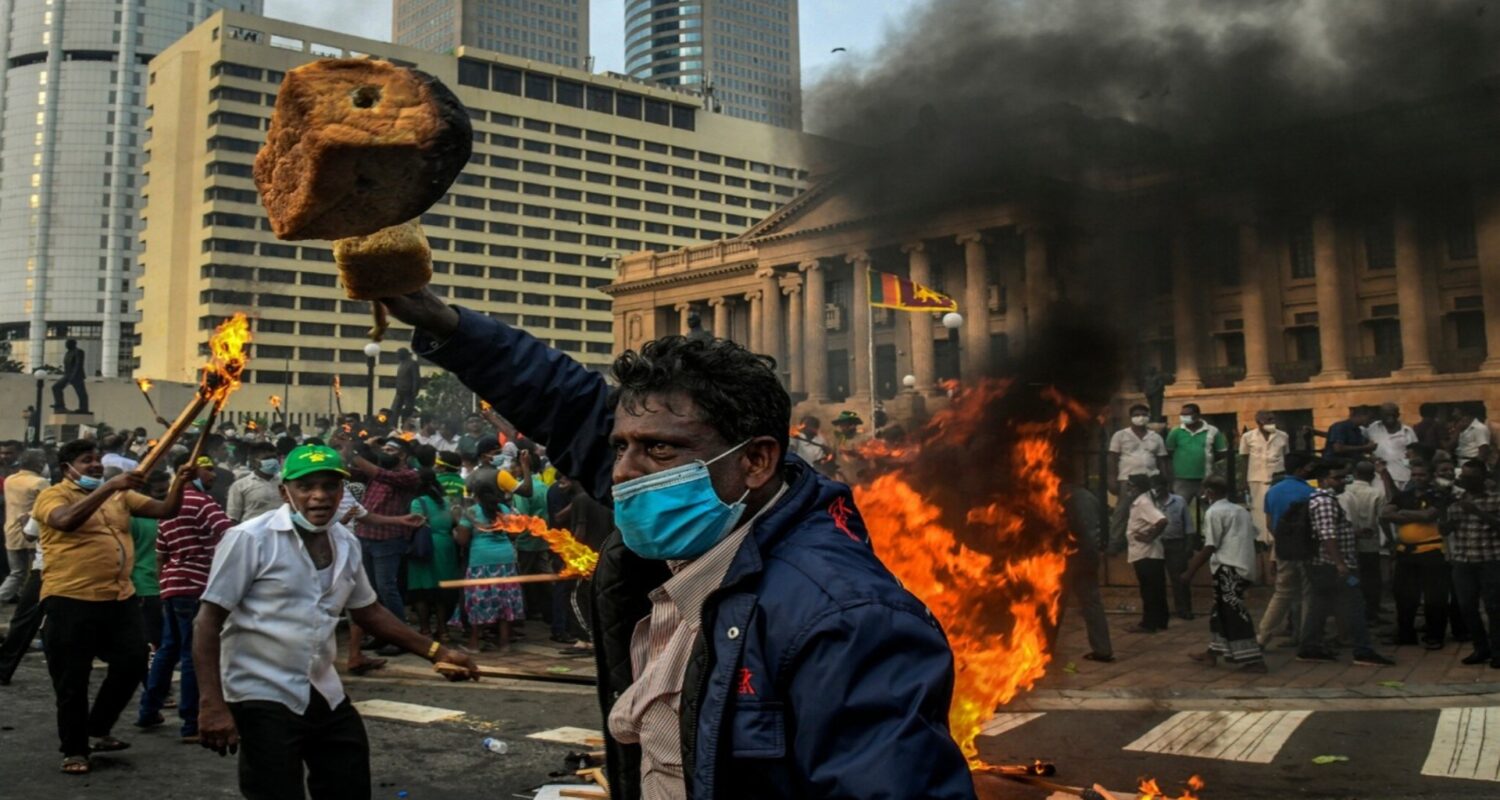
The above visualisations as reported through the outcomes of regression analysis narrates the story of Sri Lanka’s post covid economic disaster met further with political instability, civilian unrest and increased relative poverty and interconnectedness of various macroeconomic indicators with the initial core reason centred on falling forex reserves. This highlights how Sri Lanka’s inability to manage its external stability is what drove the economic crisis and could have been prioritised form the start in order to avoid this economic calamity.
To counter argue, if Sri Lanka were to prioritise on another objective, say economic growth and reducing unemployment by introducing progressive expansionary policies, firms and consumers would further spend their pockets on imported goods and raw-materials further plummeting forex reserves until they are drained to the extent Sri Lanka may have to declare a full bankruptcy and loose its capability of being a full-functional country.
Therefore, it is indisputable that prioritising external stability as a macroeconomic objective particularly with the availability of forex reserves is crucial particularly in countries like Sri Lanka which depend heavily on foreign debt and essential imports as any shortage can results in essential goods being unavailable within the economy that leads to economic contraction, higher unemployment and poor price stability as illustrated in the case of Sri Lanka.
References
Macroeconomic Chart Pack: Central Bank of Sri Lanka (no date) Macroeconomic Chart Pack | Central Bank of Sri Lanka. Economics Research Department. Available at: https://www.cbsl.gov.lk/en/statistics/economic-indicators/macro-economic-chart-pack (Accessed: April 2, 2023).
What is post-covid-19 era (no date) IGI Global. Available at: https://www.igi-global.com/dictionary/post-covid-19-era/99484 (Accessed: April 1, 2023).
Sri Lanka Foreign Exchange reserves march 2023 data – 2004-2022 historical (no date) Sri Lanka Foreign Exchange Reserves – March 2023 Data – 2004-2022 Historical. Central Bank of Sri Lanka. Available at: https://tradingeconomics.com/sri-lanka/foreign-exchange-reserves?embed%2Fforecast (Accessed: April 2, 2023).
What is post-covid-19 era? – WHO (no date) IGI Global. Available at: https://www.igi-global.com/dictionary/post-covid-19-era/99484 (Accessed: March 29, 2023).










Leave a Comment