The Fracture of Frame: Unpacking the Organic Rage and Opportunistic Hijacking of Europe’s 2026 Protests
Commuting home on a Melbourne train, Sophie was deep in her daily ritual of mindless doom-scrolling when a single, striking reel caught her eye and broke her trance. It begins with a shaky, handheld shot of a high school blockade in Lens, France, capturing the precise, horrifying moment a fifteen-year-old student is struck by a police stun grenade. The audio is a raw mix of teenage screams and the deafening pop of chemical weapons. But with a single swipe of a thumb, the algorithm transitions to a completely different reality in Milan: a hyper-edited montage of masked figures in black, completely unaffiliated with any school or union, using sledgehammers to systematically hollow out a luxury boutique to the beat of a rap track. To global outsiders watching these Pan European protests unfold in real-time form a chaotic jigsaw puzzle. Many of us are left in a deep state of thought ruminating over the source of this violence and whose story is it we are to believe. The fundamental question is whether the violence we are seeing is a inevitable extension of genuine protests centred around educational grievances, cost-of-living and police brutality or has the movement been hijacked by an opportunistic factions aiming to exploit viral riot culture for crime and destruction? In the 21st century the answers to such questions always fall into a grey area within the mind of readers, enthusiasts and everyday social media users as we are divided between competing narratives. it is immediately seized upon by politicians and mainstream media networks, who aggressively frame the narrative to suit their own agendas which are the fed into decentralised social media algorithms which spit them out into our feeds as 4K vertical spectacles. In this article, I aim to unpack the answer to this question presenting the most dominant arguments that justify both perspectives regarding the onset of violence as well as broader ideas on how media companies, political parties and algorithms can tactically frame and fracture our understanding.
The Journalistic Breakdown: What is actually happening?
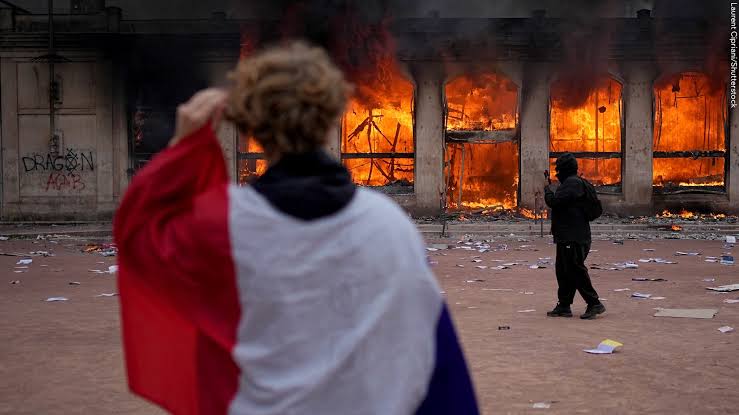
The pan-European unrest began quietly in mid-September 2026 as peaceful, student-led walkouts in France, driven by deep frustrations over crumbling school infrastructure and the hyper-competitive university admissions platform, Parcoursup. However, the tipping point arrived in early October when a 15-year-old student was severely injured by a police stun grenade during a blockade in Lens, an incident that is said to have radicalised a certain proportion of the student base translating to low-intensity incidents of violence. By mid-October, localised youth anger collided with broader social movements centred around cost-of-living frustrations and unresolve geopolitical issues spearheaded by mainstream trade unions and grassroots organisations. Driven by highly agile social media networks, identical protest scripts instantly replicated across borders, triggering severe urban clashes, arson and property damage in major cities like Milan and Brussels. Today, the dominant theory connecting these disparate cross-border riots is a profound sense of existential hopelessness, where a generation feeling economically discarded is voicing their frustration through protests, strikes and possibly violence.
The Anatomy of Attribution: What are the two theories?
The fundamental question of this article is regarding where violence originates in what appeared to be a genuine protest driven by the valid grievances of the youth demographic. The debate over the escalating violence across European cities is divided into two distinct socio-political frameworks with each offering a completely different explanation regarding the source of violence: an organic extension to the existing movement or a potential hijacking of the movement through opportunistic factions?
Theory 1: Violence as an Organic Extension to Existing Movements
This theory posits that the violence is an inseparable and predictable extension of the original movement centred around educational grievances and broader frustrations around cost-of-living. The proponents of this theory suggest that it was the structural failures of the state compounded by the aggressive policing methods of suppression that systematically radicalised the broader student based and ordinary citizens turning peaceful advocacy into a violent upsurge of rage. One could argue that the chain of events between late September and early October provide a chronological record of where the catalyst emerged. Specifically, when Evan, a 15-year-old student, had his left hand blown off by a police stun grenade during a high school blockade in Lens. Following this event, several other incidents were brought to attention including the striking of a 14-year old at close range using tear-gas canister launcher. Together, these instanced formed a definite web of proof to the public that the state was deploying war weaponry against children. Sociologists and left-wing politicians such as Jean-Luc Mélenchon, argue that property destruction is an organic and reactive shield to police brutality. As it has played out numerous times in the past, such as during the Paris Massacre (1961) and George Floyd Protests (2020), when democratic processes fail to meet basic needs and peaceful protests are met with batons and tea gas, violence becomes the only remaining mechanism to complete the protest.
Despite the chronological and past empirical evidence justifying the violence as an organic extension, this theory, like all theories, has its fair share of weaknesses driven by its tendency to sometime romanticise violence. Proponents of this theory fail to explain edge cases when violence directed at the very mechanisms or infrastructure that the movement claims to save. For instance, in France, when rioters set fire to 24 schools and firebombed public libraries, they destroy the vital public infrastructure that is central to educational grievances. Similarly, while left-wing theorists frame the riots as a unified proletarian uprising, the primary victims of the property destruction are often the working class themselves. It is the vehicles of low-income workers that are torched, and local shopkeepers whose livelihoods are ruined. By excusing this damage as “systemic blowback,” this theory ignores how the violence fractures the broader social solidarity needed to win policy concessions. However, the most dangerous repercussion of claiming this theory lies in the erasure of agency. When violence is treated as purely reactive and an inevitable reaction to police brutality, there is potential that it could provide socio-political conditions required for criminals and underworld factions to further derail the vicious cycle of violence and exploit other forms of crime. This feasibly leads to the second theory behind the violence.
Theory 2: Violence as De-Coupled Perpetration By Opportunistic Factions
In contrast to lack of separatism of Theory 1, Theory 2 argues that the violence is entirely decouple from the original grievances of the student and labour movements. It argues that it is perpetrated by high organised and extreme political cells or criminal opportunists who deliberately infiltrated the margins of the protests to exploit chaos. The violence in Italy provides a witness-backed trail of events that strengthen this theory. What began in central Milan as a sanctioned, peaceful demonstration against the high cost of living was abruptly hijacked in the historic Piazza del Duomo. Witnesses and student collective representatives confirmed that the peaceful march was intentionally disrupted by a separate, distinct faction of masked, black-clad youth groups who arrived with firecrackers and smoke bombs. These actors used the crowds as human shields while they set fire to construction sites and looted high-end storefronts. In contrast to Theory 1, this model appears to championed by institutional authorities across Europe. Both French President Emmanuel Macron and Italian Prime Minister Giorgia Meloni have both aggressively pushed this narrative, explicitly framing the rioters as “hooligans” rather than legitimate protesters. Investigators from Le Monde highlight that a significant portion of those arrested including over 2,400 detentions in France possess an array of pre-prepared tactical gear, linking them to professional anarchist networks and fringe groups who use social media to hunt for vulnerable public gatherings to destabilise.
While this theory carries institutional backing and witness-based evidence, its main weaknesses stem from scale inconsistencies, group separation and its use as protective political shield. There is also the scaling inconsistency: When a country sees over 2,400 arrests in a single weekend and hundreds of thousands of people blockading roads, it becomes statistically impossible to attribute the chaos entirely to a few hundred black-bloc infiltrators. The sheer scale could suggest that the radical tactics have achieved a degree of mainstream, popular acceptance among the protesting demographic. It is also inherent in this theory that protesters and violent rioters are treated as two separate groups. Instead, it could be that a fluid and symbiotic relationships exists between them where the peaceful crowd provides a protective shield towards radical actors as they both have the same fundamental enemy: the state. However, the biggest structural weakness of this theory lies in historic use as convenient political shield used by the state to evade accountability. By focusing exclusively on the broken glass and the pre-prepared tactical gear of rioters, politicians like Macron and Meloni use the “hijacked” narrative to change the subject. It allows the state to reframe a profound economic and social failure (the cost-of-living crisis and public debt collapse) into a simple, black-and-white issue of public law and order, absolving the government of its duty to negotiate.
The Distortion of Narratives: How are these theories reframed through mediators?
When raw violence enters the media ecosystem and lands in vertical video format on social media like on Sophie’s instagram page, these theories are stripped off from their relatively neutral and logical orientation. Instead, the two foundational theories (Organic Rage versus Opportunistic Hijacking) are quietly reframed by external mediators such as mainstream news networks, weaponised social media algorithms and global political figures. These actors have the resources to actively filter, omit and reorganise broader narratives around the unrest to feed their own agendas which frequently obscure the average outsider from truly understanding what is unfolding in Europe as of now. In this article, I focus on four primary distortions ranging from ethno-nationalist debates to political culture wars.
1. The Ethno-Nationalist Distortion (The Immigrant & Anti-Islamic Frame)
Through the perspective of right-wing media outlets, nationalist politicians and global commentators, civilian violence is a powerful tool that can be easily reframed to validate theories around anti-immigration. By shifting the blame from socio-economic despair to cultural incompatibility, they use the riots to generate civilisational anxiety. For example, when a school or storefront is set on fire in a Parisian suburb (banlieue) or near Milan’s central station, accounts on X (formerly Twitter) and Telegram surgically strip the footage of its original context. High-profile international figures, including Donald Trump, frequently amplify this imagery to a global audience as an existential warning that “Europe is losing control of its borders” providing sufficient proof to back the president’s own anti-immigrant crackdowns. Amongst these narratives, anti-Islamic frames have a particular emphasis. Regular discourse on platforms like Threads and X routinely demonstrate footage of the violence by overlaying it with xenophobic captions, misidentifying secular student protesters as radical Islamists, and falsely claiming that local mosques are anchoring the unrest. Ultimately, these arguments serve no purpose in advancing the valid grievances that landed the protests in the first place. Instead, it gradually erases the true identify of the student protesters and along with it their valid grievances replacing them with broader issues around border security, immigration and Islam.
2. The Intergenerational Caricature (The Anti-Gen Z & Alpha Frame)
While the ethno-nationalist lens reduces economic pain to racial tension, mainstream television networks and older-demographic commentators utilise a different tactic: reframing the visual chaos into a sweeping indictment of modern youth. By shifting the focus from structural macroeconomic failures such as systemic housing hyper-inflation and decaying educational infrastructure to individual moral failure, these outlets exploit the riots to trigger a deep societal panic over “lawless” youth. When media coverage surgically prioritises close-up footage of teenagers looting high-end consumer brands like Apple or Hermès over wide shots of peaceful, multi-generational trade union marches, it signals to the viewer that this is an act of consumerist opportunism rather than systemic despair. Talk shows and op-eds seamlessly weave these images into a broader narrative about parental failure, screen addiction, and the downfalls of the “TikTok generation,” providing older audiences with a comfortable, familiar explanation for a complex crisis. Ultimately, this framing ensures that the end-user perceives the unrest not as a rational political emergency, but as a behavioural malfunction. It strips the true financial precarity of the student protesters from the public consciousness, replacing it with a dismissive caricature of teenage entitlement.
3. The Geopolitical Weaponization (The Left vs. Right Global Culture War)
This intergenerational friction is easily co-opted on a global scale, where international political strategists transform the localised pain of European cities into a high-stakes proxy battleground for the global culture war. Once the protests are stripped of their hyper-specific domestic realities, such as France’s crushing debt-to-GDP ratio or Italy’s rigid labour market, both left- and right-wing media machines re-code the violence into a generic scripts designed to manipulate partisan anxieties. For the progressive media consumer, digital creators frame the street clashes through a romanticised lens of an idealised, anti-capitalist revolution, frequently sanitising or ignoring the devastating economic toll that property destruction takes on local, working-class communities. Conversely, right-wing networks package the exact same burning streets as the inevitable, apocalyptic consequence of “woke,” progressive governance and weak-kneed western leadership. For the global outsider watching this unfold, the actual material demands of the protesters, like fuel price caps or admissions reform, are entirely swallowed by this polarized political divide that continues to define the modern day and age just as it did during the Cold War.
4. The Algorithmic Spectacle (The Gamification of Crisis)
The ultimate delivery mechanism for these distorted narratives, however, is the very architecture of short-form video platforms like TikTok and Instagram Reels which automatically process and optimise real-world political violence to feed an insatiable appetite for digital engagement. By prioritising visual shock and intense emotional triggers, the algorithm renders the underlying ideological debates completely irrelevant, transforming a political tragedy into a hyper-polished consumer product. For the end-user scrolling through their feed, like Sophie, the crisis arrives completely detached from journalistic commentary, presented instead as a series of seven-second, cinematic spectacles (burning townhalls and dramatic police charges) edited to the rhythm of aggressive drill music. This constant exposure to such violence creates a dangerous loop of double distortion; it detaches the viewer from the human reality on the ground and gamifies reality to cater to our entertainment need. Simultaneously, it could also fundamentally alter the behaviour of the rioters themselves, who realise that the algorithm directly rewards visual escalation with millions of views, creating a feedback loop where property destruction is performed as much for digital clout as it is for political leverage.
Conclusion
Ultimately, the fire storms in Paris, Brussels and Milan are no longer about education, cost-of-living or macroeconomic failures. For everyday observers like Sophie, looking at the world through a train window in Melbourne, the actual, material suffering of European youth is virtually unreachable. It is buried beneath a highly engineered media funnel that demands a binary choice: view the unrest either as an unprovoked criminal assault on Western civilisation or as a romanticised anti-capitalist revolution. By forcing the messy reality of the streets into these rigid, pre-packaged ideological templates, the public sphere has suffered a profound structural failure. The genuine, cross-border crisis of existential hopelessness—where a generation feels completely discarded by its own state infrastructure—is systematically starved of political oxygen. When we allow short-form algorithms and opportunistic political figures to completely control the narrative frame, we lose something far greater than property or storefronts. We lose our collective ability to witness a crisis for what it truly is: a desperate, generational cry for a viable future.