Meaning Under Pressure: The Existential Lyrics Driving ESC 2026’s Lithuania & Czechia
Meaning Under Pressure: The Existential Lyrics Driving ESC 2026’s Lithuania & Czechia
Eurovision has never been short on spectacle. Each year, our screens erupt in glitter cannons, epileptic lighting and the occasional prop that leaves viewers questioning both physics and artistic intent. Yet beneath the theatrics, almost every entry tells a story condensed into a 3-minute performance with themes ranging from stoic narratives, cultural substance, social commentary or just pure ESC nonsense. In 2026, two such entries stand out amongst a plethora of those entries that are noted for their lyrical depth: Lithuania and Czechia. Lithuania’s Lion Ceccah with Sólo quiero más and Czechia’s Daniel Žižka with Crossroads arrive at Eurovision 2026 not merely as pop anthems, but as dispatches from the human condition tackling highly existential themes leaving you in an internal state of Socratic questioning. With both entries being artist-led (written and conceptualised exclusively by the artist), this article analytically compares the lyrics of each entry across three interconnected existential ideas: fracture choice, the role of authority and the pursuit of nothingness.
The Fracture of Choice: Tangled Strings, Shrouded in Fog
Both songs fundamentally tackle the same existential theme, the crushing weight of human choice, but in their own divergent ways.
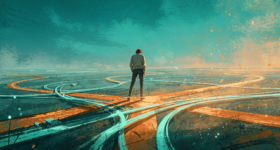
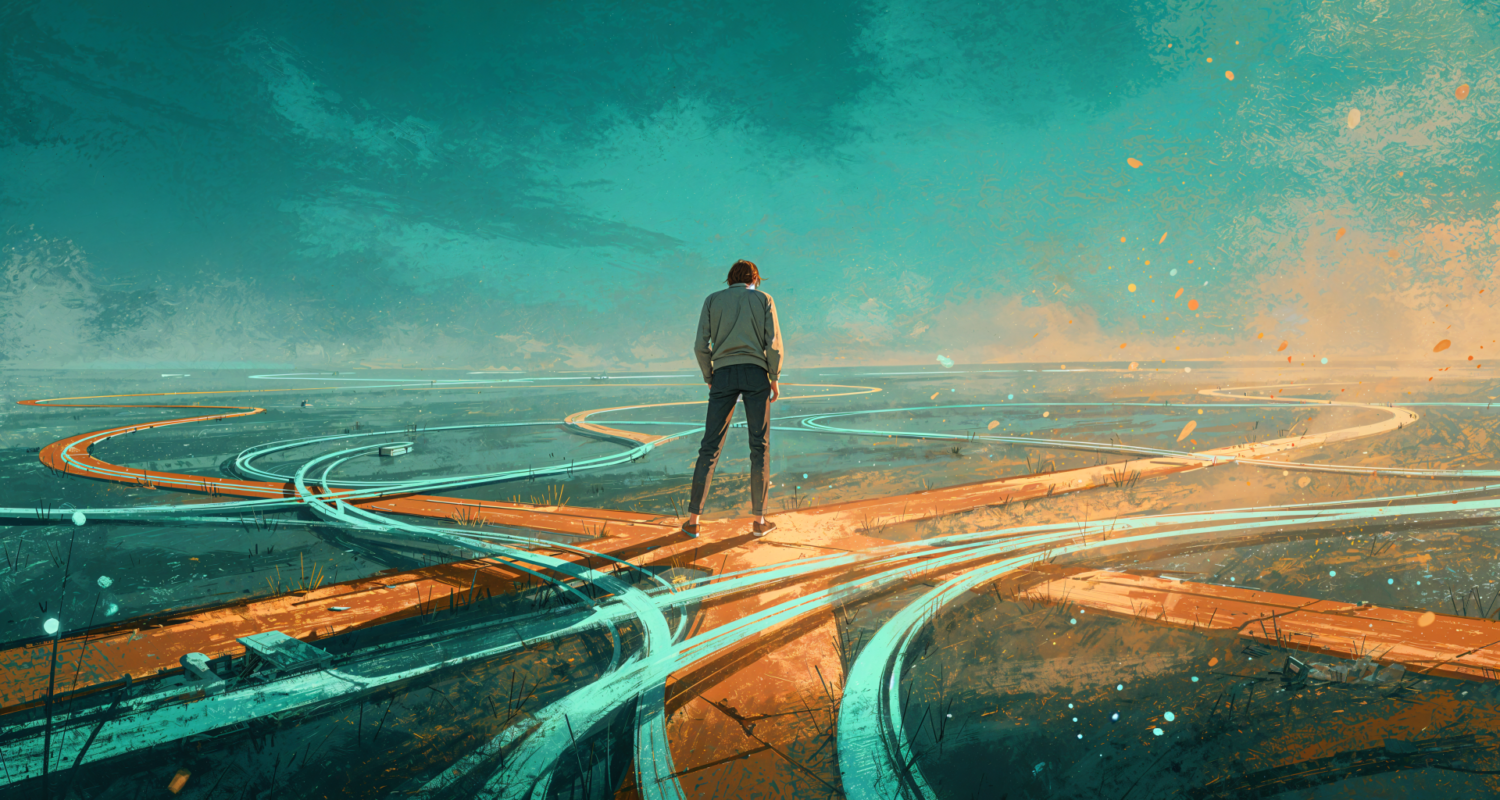
Žižka’s Crossroads is the more anxious of the two songs, its imagery deliberately paints an unstable yet quiet landscape – a hollow jar that cannot reach the “ocean floor”, “tangled strings” and a”vicious spider web”. These metaphors do not converge to a unified image and that is precisely the song’s literary contribution regrading the nature of choices in shaping our exercise of freedom in an otherwise absurd world. Jean-Paul Sartre, a renowned existential philosopher, famously coined the idea of Anguish – because objective moral rules are hard to define, every choice we make is a solitary act of creation that carries the weight of total responsibility. This idea is well-encapsulated within the lyrics of Crossroads, putting forward the proposition that choices do not simplify reality as we are made to believe – they fracture it. Every decision doesn’t close a door; it splinters the path further, revealing new strings, new spiderwebs and new crossroads. Žižka’s lyrics also appear relevant in a day an age where the world appears more absurd than ever: His plea to his own mother or mother nature itself reflects this empathetically – “Mother, I’ll get lost without a map” is the emotional hinge of the song, a son reaching back toward certainty in a world that no longer offers any.
In contrast, Lion Ceccah begins from a place that might seem superficially simpler but proves on closer reading to be philosophically advanced. While Žižka stands paralysed at the crossroads, Ceccah seems to have already passed through it and emerged on the other side, not with answers but with a deeper, more troubling question that is likely to lead to another wave of fractured choices. The opening verse of Sólo quiero más (Based on an official translation from Lithuanian to English) is quietly devastating: “It frightens me, haunts me everywhere I am / Those who dare, ask: why do I live?”. The second verse compounds this: “I keep spinning again and again, the shores of truth are shrouded in fog”. Universally, across philosophical traditions, humans are urged to look inward to derive meaning. Yet time and again, the stories of great thinkers—from Socrates to the Buddha to the mystics of every era—suggest that introspection rarely delivers the neat clarity we expect. Instead, it often exposes deeper contradictions, more unsettling questions, and a sense that meaning is something we must continually reconstruct rather than discover. Ceccah’s lyrics sit squarely in this lineage: not the voice of someone beginning an existential journey, but of someone who has already walked through the fire of self‑interrogation and realised that the search itself may be the only constant. Through this lens, the song’s titular plea – “I want more” – is not an expression of greed but the cry of a humanity dissatisfied with the hollow answers its own choices have produced.
The Role of Authority: Mad World and Golden Cages
If the first theme questions the nature of choice, the second asks what we choose to submit to and both songs arrive at a partial verdict on the structures humans erect to escape the burden of the world.
Žižka is startlingly direct. “We try our best to operate on pure love and rage / Ungrateful child in a golden cage”. This is one of the most arresting images in his lyrical story: love and rage reimagined as humanity’s most primal forces (energies we like to frame as liberating, yet which ultimately power the very machinery of human existence). The golden cage is an equally vivid symbol: it represents a life shaped by expectations, comforts and identities we never consciously chose and it these structures that glitter from the outside yet constrict us from within. Once again, Sartre’s ideas, especially his notion of bad faith, feel very relevant here. Bad faith is the act of convincing oneself that one’s situation is fixed and externally determined; it is often seen as the surrender of freedom disguised as necessity. Žižka’s “ungrateful child” inhabits precisely this condition, dimly aware of the bars yet unable, or perhaps unwilling, to name them. The most haunting lyric that closes the bridge of Crossroads before the high notes start to rise is the moment the song finally admits its most blunt truth – “Man cannot change”. In Žižka’s framing, this statement reflects that humanity keeps living in bad faith, avoiding the big questions and surrendering to the pull of authorities, systems, and inherited structures. We stay in the golden cage not because we must, but because we accept it—mistaking constraint for comfort and choosing the familiar over the terrifying work of change.
Sólo quiero más approaches the same trap but lists this traps and achieves a conclusion regarding their role in the creation of meaning. In the chorus, Lion Ceccah creates a powerful image and subsequently a thought experiment: “Even if there’re no more gods to pray for / Even if we’re standing as the sky falls” — in two lines he dismantles both religious and cosmic authority as possible sources of meaning. This is not nihilism but something closer to what Sartre meant by radical freedom: the moment one accepts that no higher order will hand down purpose, one is finally, terrifyingly, at liberty to create it. The absence of gods is not a catastrophe in Ceccah’s universe but a clearing — a space in which the bigger questions about human meaning can finally be asked. And crucially, he doesn’t replace God with ideology, institution, or romantic love, the usual substitutes humans reach for when one golden cage collapses. He replaces nothing. He simply continues wanting. In this sense, Sólo quiero más becomes the more philosophically consistent position: if the cage is a form of bad faith, the only honest alternative is to refuse all cages and remain in the uncertainty of open water. It is a posture that accepts meaning as something to be made, not inherited, and recognises that the search itself may be the only stable ground we ever stand on.r.
The Pursuit of Nothingness: Man Cannot Change
At the end of both journeys, the songs converge on the same uncomfortable truth – Humanity, in these two visions, is a condition that exists and at its universal core we are unlikely to change.
Žižka delivers his verdict in the song’s final line: “Man cannot change”. It lands with almost flatness with no drama or consolation. Read within the framework of the song, the line carries a kind of Stoic weight. Marcus Aurelius returned again and again to the distinction between what lies within our control and what does not. The external world, other people, the direction of history — none of these can be mastered. What remains is the quality of our response. Žižka’s conclusion follows this logic. The human tendency to fracture reality through choice, to step into golden cages, to search for maps in a world that cannot be mapped — these are not errors to be fixed. They are part of what it means to be human. The final word of the song is not a solution but a position: Crossroads. It marks a loop rather than an ending.
Lion Ceccah arrives at the same destination, but by a longer and more troubled route. “Pain and joy, that is life / like an old film, pain creates music that connects without words” — here the song reaches its most reflective point, suggesting that suffering is not separate from meaning but one of its sources. This aligns closely with Nietzsche’s idea of amor fati: accepting the whole of existence, including its difficulty, as the ground on which a real life is built. Towards the end of the song, the title (originally in Latin) is repeated across seven different languages. Similar to Žižka’s universal declaration that “Man cannot change”, this is Ceccah’s way of expressing the universality of the human condition: we will never be fully satisfied with our answers to the big question, and we will keep building systems, structures, and cages that hold us in place. They offer only a brief sense of meaning, just enough to carry us forward, but never enough to resolve the deeper uncertainty that follows us through life.
We are caged and lost animals, and instead of resolving our deep‑seated need to draw meaning from life, we keep building new cages to create small, personalised versions of meaning. These structures only multiply the choices available to us, leaving us caught in fractured webs of paths that never lead to lasting satisfaction. We keep wanting, keep searching, and keep falling short of the “enough” we imagine exists somewhere ahead. In the Eurovision world of three‑minute pop songs, that is not a small claim — which makes Lithuania’s and Czechia’s entries unusually bold contributions to the contest’s artistry and certainly to existential philosophy.