Cinema as Resistance: How The 2025 Best Picture Nominees Challenge Injustices, Power and Society
The fervent race for the Oscars’ most coveted prize -Best Motion Picture of the Year- is often seen as a contest in which victory is claimed by a film that flawlessly executes cinematic excellence by checking every box of artistry, storytelling and technical mastery. However, with cinema’s inherent predisposition to political scepticism, the race for Best Picture is often seen as a stage for quiet rebellion in which ideas compete that mirror the deep-seated issues of society or expose inconsistencies within the film industry. For example, when Parasite shattered barriers in 2020, it was not just a victory for international cinema but a statement against Hollywood’s insular tendencies while providing an avant-gardist perspective on the limits of capitalism. Similarly, following the infamous snub of Brokeback Mountain in 2006, when Moonlight triumphed over La La Land in 2017, it felt like a long-overdue reckoning in which the Academy finally embraced the poignant nature of queer love and sought to oppose the homophobic rhetoric that spurred following the US marriage equality legalisation in 2015. In this piece, I will briefly examine some of most stand-out Best Picture Nominees of 2025 and unravel the political and humanistic themes that linger beneath its frames illustrating how each film delivers a contextually-relevant and ideologically rich message for the world to embrace.
Contextualising The 2025 Oscar Race
In 2025, the race for Best Picture unfolds within a whirlwind of controversies, challenges and the absence of a clear front-runner adding layers of mysticism that make this year’s awards season one of the most unpredictable in film history. Furthermore, in an era defined by a resurgent conservative political climate, where the Trump administration’s relentless grip on immigration, artistic expression and minority rights collides with escalating global tensions and the rise of authoritarian-leaning world leaders, an age-old question emerges – To what extent does cinema still have the power to challenge the presence of power within society itself? This year’s Best Picture nominees do not shy away from provocation. From audacious political allegories to deeply intimate narratives, they confront the complexities of our time with a rawness that demands attention. However, the question on whether cinema still retains its capacity to change the systematic issues it addresses remains a mystery worthy of further exploration. In this list, I compile the most outstanding best picture nominees, from what I have seen, that I believe the most compelling narratives, in order of significance.
The Brutalist
 The Brutalist is a monumental masterpiece that could very well earn its respect as one of the greatest and most ambitious films of the 21st century. Directed by Brady Corbet, The Brutalist chronicles the story of László Tóth, a visionary Hungarian-Jewish architect and Holocaust survivor, who, alongside his wife Erzsébet, seeks to reconstruct their lives in post-war America. Their tumultuous journey takes a transformative turn when the enigmatic industrialist Harrison Lee Van Buren offers László a commission that promises to redefine their lives as immigrants and change the paradigm of modern brutalist architecture. This story has been empathetically narrated through the superlative performances of Adrien Brody, Felicity Jones and Guy Pearce who have each been nominated in their respective category. Furthermore, the film also executes technical mastery with a majestic score, production design and cinematography making it a well-round film that I believe is the most worthy of the night’s top prize. Beyond ticking the boxes of cinematic excellence, the film captures the birth of Modern America as it transitions from its old wild western days to a cosmopolitan capitalist urbanscape. This transformation is captured through László’s story, whose attempt to seek freedom in the American Dream is interrupted when he confronts the gritty realism of US Capitalism that hurts the people living on the fringes of society.
It is through László’s professional relationship with Harrison Lee Van Buren in building a community centre that he navigates the evils of materialism, institutionalism, exploitation and cultural homogenisation as he resists compromising his artistic freedom in the name of corporate greed which proves to a bitter journey with many twists and turns. The film’s finale features László’s final building, a brutalist masterpiece, that embodies the outcomes of America’s transformation – designed with the dimensions of a concentration camp to symbolise economic oppression, a cross at the ceiling to reflect spiritual decline, glass ceilings to expose the illusion of free thought, a hollow core representing the emptiness of the American Dream, labyrinthine hallways signifying bureaucratic entrapment, and vertical stratification that mirrors USA;s class divide. All in all, The Brutalist is well-round film with ideologically rich themes that critique USA’s social and political architecture which comes at a time in which people are beginning to question the limits of capitalism and corporate greed. Therefore, in my opinion, this film is the most worthy of the top prize and with a budget of US$10 million, this signifies a remarkable achievement in independent film history.
The Substance
 Another stand-out feature is The Substance, an inventive body-horror masterpiece that brutally tackles issues of body image, industrial beauty standards and aging through a feminine perspective whilst critiquing the power play between artists, producers and shareholders. Directed by Coralie Fargeat, The Substance delves into the harrowing journey of Elisabeth Sparkle, portrayed by Demi Moore, a once-celebrated Hollywood starlet who, upon being dismissed from her long-standing aerobics show due to ageism, resorts to a clandestine drug promising rejuvenation. This experimental serum bifurcates her existence, birthing a younger alter ego named Sue, portrayed by Margaret Qualley. Bound by the stringent “seven-day rule” Elisabeth and Sue must alternate consciousness weekly; failure to adhere results in catastrophic physical degeneration. It is an out-of-the-box and monumental achievement that a film that oddly reflects the style and principles of French Extremity Body Horror is being recognised by the academy. Fargeat masterfully executes her vision alongside superlative performances by Demi Moore and Margaret Qualley as well as technical mastery in fields like editing, score and makeup and hairstyling. Through her unprecedented film, Fargeat’s message remains straightforward in rendering the internal violence women have against their bodies when their self image fails to remain congruent with their ideal image that is socially-constructed to reflect the absurd beauty standards of society, which in the film’s case is being specifically highlighted with regards to the Hollywood Film industry.
A fundamental prerequisite to truly grasping this film lies in recognising that Sue and Elisabeth, while inhabiting a single physical form, exist as dualistic manifestations of the human consciousness that are constantly vying for control. These manifestations operate one at a time within a dichotomous environment in which their conflicting desires lead to the downfall of the entire physical form. Elisabeth, representing the older entity, envies her younger self and desires to equalise two entities in terms of physical appearance by binge-eating which deteriorates her appearance. Meanwhile, Sue, representing the younger entity, resents her older self and desires to side-line her presence by forcibly disobeying the 7 day rule. This realisation reflects the inner conflict that plagues our minds when we evaluate the congruency between our self and ideal images whilst rendering the achievement of body satisfaction as a vicious cycle that is difficult to escape. While the film brims with layered symbolism, intricate motifs, and bold cinematic, its essence remains unwavering. At its core, the film critiques the obsession women develop over their bodies as result of a societal narrative that commodifies youth, punishes aging, and pressures individuals to reshape themselves to remain desirable. Through its haunting imagery and psychological depth, Fargeat has set the record straight in calling us recognise the conflicts that punctuate within our consciousness as we evaluate our self-image and seek to action any incongruencies.
Emilia Pérez
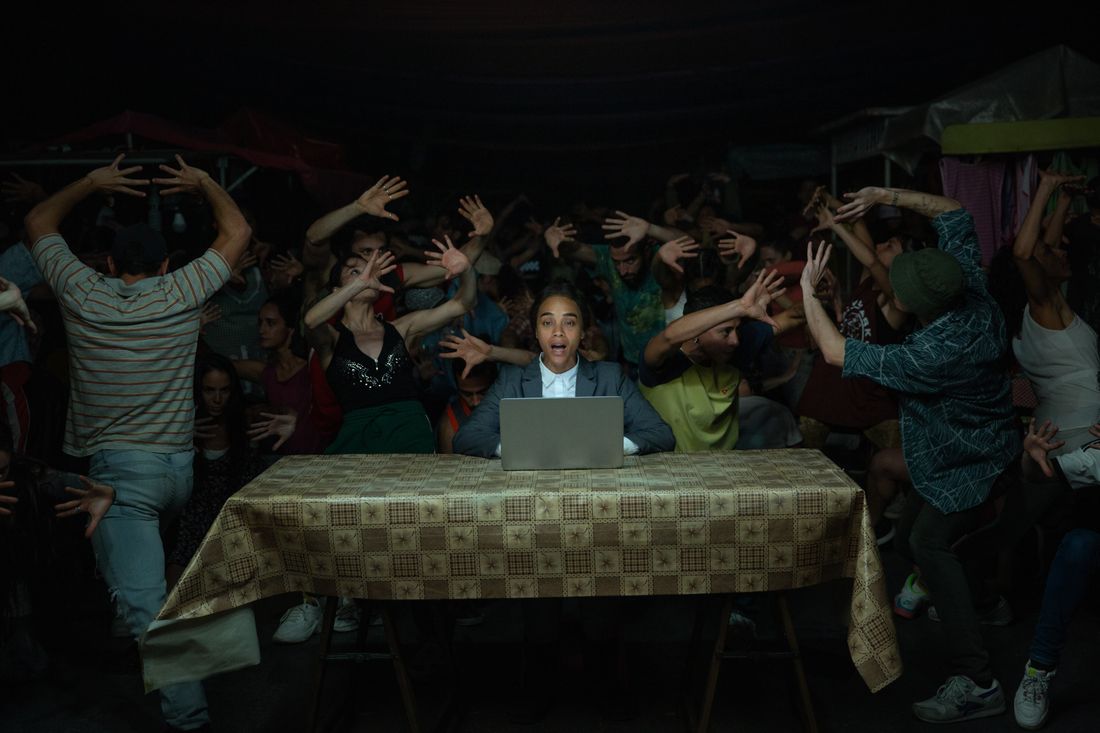 France’s submission to the Oscars, Emilia Pérez, is another outstanding endeavour that establishes itself in cinematic history as a resilient film that defies categorisation. Directed by Jacques Audiard, Emilia Pérez weaves the gripping tale Rita, a brilliant yet struggling lawyer, who finds herself entangled in a dangerous Mexican underworld when she is hired by a cartel leader, Manitas, who seeks her expertise in faking his death and transitioning into a woman, Emilia Pérez, in order to escape his life of crime and undo his past wrongdoings. Instantly, we are introduced to a morally questionable premise in which a fundamentally immoral character is granted a redemption arc working against the laws of morality. Despite being hailed and embraced by industry guilds, Emilia Pérez faced waves of controversy, criticised for its perceived lack of authentic Mexican and transgender representation, sparking heated debates over cultural appropriation and the reinforcement of harmful stereotypes. However, I believe the outrage over this film stems from a fundamental misunderstanding of the film’s core humanistic themes as we operate within a divisive political environment in which we overemphasise cultural and political correctness over empathising with the narrative of a film. At its heart, I believe Emilia Pérez is one of the most bold and provocative films of the 21st century that deserves its many accolades and honours irrespective of the outrage.
One of Emilia Pérez’s most distinctive features is its refusal to conform to a single genre, defying conventional categorisation. Originally structured as an opera, the film boldly merges a wide array of cinematic styles, from musical and soap opera to telenovela, crime-thriller and drama. This eclectic fusion creates a vibrant yet unpredictable narrative, marking it as one of the most unique and ambitious films in recent memory. However, if I were to categorise Emilia Pérez, I would classify it on the basis of its ideological richness as an existential thriller, delving deep into the complexities of identity, transformation and the profound consequences of self-reinvention. One of Emilia Pérez’s most captivating aspects is its refusal to conform to a single genre, defying conventional categorization. Originally structured as an opera, the film boldly merges a wide array of cinematic styles, from musical and soap opera to telenovela, crime-thriller, and drama. This eclectic fusion creates a vibrant yet unpredictable narrative, marking it as one of the most unique and ambitious films in recent memory. As Zoë Saldaña eloquently states, beyond its gripping, plot-driven premise, Emilia Pérez is, at its core, a story of four women fighting to claim their radical freedom and become the most authentic versions of themselves, escaping a life lived in bad faith. For one, it means breaking free from the grip of crime and seeking redemption; for another, it is the pursuit of financial stability, the search for love after deep trauma, or the simple yet profound act of self-acceptance. Yet, not all of them reach their true selves, and in their struggle, the film unveils a painful truth. Emilia Pérez is ultimately a meditation on identity, exposing the dire consequences of denying one’s essence while urging us to find empathy – even for those who exist in the darkest corners of society.
Conclave
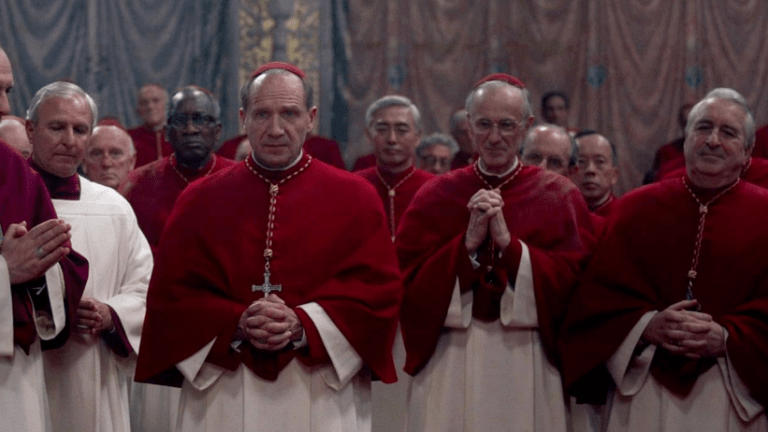 Conclave, directed by Edward Berger, offers an intimate glimpse into the secretive world of the Vatican’s papal election, weaving a narrative rich in suspense and character complexity. The papal thriller begins with the sudden death of the Pope, prompting the College of Cardinals to convene in a secluded conclave to elect his successor. Among the prominent contenders are Cardinal Aldo Bellini (Stanley Tucci), a progressive voice advocating for modernization; Cardinal Joshua Adeyemi (John Lithgow), a socially conservative figure with a strong moral stance; Cardinal Joseph Tremblay (Ralph Fiennes), representing moderate views; and Cardinal Goffredo Tedesco (Sergio Castellitto), a staunch traditionalist yearning for a return to old rituals. The arrival of the mysterious Archbishop Vincent Benitez (Isabela Rossellini), appointed secretly by the late Pope, adds an unexpected twist to the proceedings. As the cardinals navigate political manoeuvring, personal revelations and ethical dilemmas, the film masterfully portrays the tension and gravity of their decision-making process. The narrative is further enriched by stunning cinematography that captures the grandeur of the Vatican and a haunting score that underscores the film’s dramatic moments. Conclave has garnered critical acclaim for its compelling storytelling and exceptional performances, earning it a place among the notable Best Picture nominees at the 2025 Academy Awards.
Beyond its intricate plot, Conclave delves into profound ideological themes, reflecting the broader liberal and conservative divide that characterizes contemporary society and especially in the USA where it plays out as a “culture war”. The film’s portrayal of the papal election serves as a microcosm of today’s political landscape, highlighting the clash between progressive ideals and traditional values within the Church. Cardinal Bellini’s push for modernization mirrors the liberal agenda for inclusivity and reform, while Cardinal Tedesco’s traditionalism echoes conservative calls for a return to foundational principles. This ideological tug-of-war is further complicated by personal ambitions and hidden agendas, mirroring the political polarisation evident in the 2024 US Presidential election. The film also addresses issues of identity and authenticity, particularly through the character of Archbishop Benitez, whose unexpected presence challenges the status quo and forces the cardinals to confront their biases and preconceptions. Conclave thus not only provides a gripping narrative but also prompts viewers to reflect on the complexities of leadership, the challenges of ideological polarisation and the enduring struggle between tradition and progress in shaping the future of institutions. In a digital age in which political beliefs divide us, Conclave asks us to reassess our belief systems and embrace difference, uncertainty and the diversity of though as higher virtues.
Anora
 Our final stand-out feature and the predicted winner of the best picture race, Anora, directed by Sean Baker, is a compelling comedy-drama that delves into the complexities of love, power and class within the vibrant Russian-American community of Brighton Beach. The film follows Ani, portrayed by Mikey Madison, a naïve lap dancer whose life takes an unexpected turn when she marries Vanya, the son of a Russian oligarch. This union propels Ani into a world of opulence and intrigue, challenging her perceptions and resilience. Baker’s direction seamlessly blends elements of screwball comedy with social realism, creating a narrative that is both entertaining and thought-provoking. The film’s authenticity is further enhanced by its diverse New York settings, capturing the essence of the city’s multifaceted culture. Madison’s performance has been widely acclaimed, earning her a BAFTA award and an Academy Award nomination for Best Actress. Anora has also achieved significant box office success, grossing over $40 million worldwide, a testament to its broad appeal and critical acclaim.
Beyond its engaging plot, Anora addresses profound ideological themes, shedding light on the intricacies of the sex industry and the human stories within it. The film treats sex work with respect and empathy, challenging societal stigmas and offering a nuanced portrayal of those within the profession. Ani’s relationship with Vanya underscores the transactional nature of certain relationships, prompting viewers to reflect on power dynamics and authenticity in human connections. The stark class divide between Ani’s modest upbringing and Vanya’s wealth highlights societal disparities, emphasising the challenges individuals face when crossing socioeconomic boundaries. Anora invites audiences to empathize with characters often marginalised, encouraging a deeper understanding of their struggles and aspirations. While the film displays its themes it full lights, in my opinion, it is the weakest of all nominees in that it lacks any form of depth or substance that would have enhance the film’s thematic portrayal of its issue. Nevertheless, excluding its R-rated explicit scene, it is a film that can be delivered to diverse audience whose message can be easily digested at the surface level.