
Dragons, Myths and Pearls: Reimagining Tomorrowland as a 21st Century Heterotopia
Dragons, Myths and Pearls: Reimagining Tomorrowland as a 21st Century Heterotopia
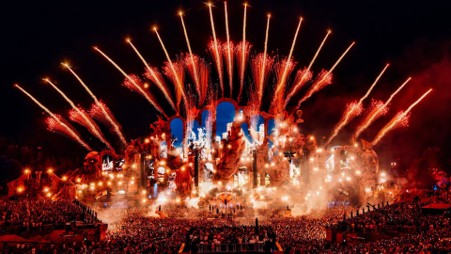
Tomorrowland is famed for being a dazzling and hyper‑stimulating EDM festival that transforms the usually quiet countryside of Boom, Belgium into a vast playground of sound, colour and spectacle.Yet when you stand before 400,000 ravers bathed in epileptic light displays, animatronic dragons looming overhead and pearls traded like relics, it’s impossible to shake the sense that something deeper is unfolding. To make sense of this atmosphere, we can turn to Michel Foucault’s concept of the heterotopia—the analytical lens through which this article interprets the unqiue universe of Tomorrowland.
In the study of how we experience space (phenomenology), a heterotopia is a real, physical place that exists outside of normal societal rules, simultaneously mirroring and inverting the spaces of everyday life. Unlike a utopia, which is an unattainable ideal with no real-world coordinates, Tomorrowland is a very much a tangible world that functions almost like a micro-society. In the span of a few weekends, this micro-society replaces the rigid, mundane structures of our daily lives with its own distinct rules, rituals, and values. This short analytical piece delves further into this idea, carefully unpacking the various structural elements of Tomorrowland that reinforce the event as a heterotopia on its own.
An Alternate Universe: Currency, Experiential Branding and the Servicescape
Walking through the gates of Tomorrowland feels like stepping through a looking glass making it hard to realise that behind every aspect is a meticulously planned process. The festival operates as a masterfully engineered servicescape — a total physical environment designed to manipulate our senses and sustain an unbroken fairytale-like aesthetic.
What fascinates me most is how deliberately the festival isolates us from the material logic of the world. For example, consider the festival’s proprietary cashless currency, “Pearls”. By forcing you to exchange real-world money for digital Pearls stored on a wristband, Tomorrowland elegantly exploits a classic behavioural economic trick. It completely removes the “pain of paying”. When you are tapping a plastic bead to buy a drink, the psychological friction of spending hard-earned money vanishes and is replaced by a sensation of paying with play-money in a fantasy world. While this may operate as a clever commercial gimmick, it also reveals just how far the festival’s organisers are willing to go to fully immerse their audience.
The illusion of Tomorrowland being an alternative universe begins long before you reach the venue. Each year, a novel is published to welcome attendees into the festival’s deeply complex lore. This novel establishes the official narrative theme, character factions and magical backstory that the massive physical mainstage and festival grounds will bring to life. Additionally, through their “Global Journey” packages, Tomorrowland brands entire chartered flights and trains.
The event has mastered the art of controlling your environment from the moment you leave your home country. It is a brilliant, closed-loop ecosystem where commercialism is beautifully camouflaged as magic, creating a hyper-branded alternate universe that feels entirely detached from global capitalism. In this Tomorrowland already establishes its heterotopic identity but it can be only be fuelled further by what takes placed during the event.
Dissolution of Self: The Neo-Tribal “People of Tomorrow”
Once inside this counter-site, the social identities we wear like armor in the outside world begin to fracture. Tomorrowland unites its wildly diverse audience under a singular, almost mythic slogan: “Live Today, Love Tomorrow, Unite Forever”. Unlike other event slogans, Tomorrowland’s slogan is impecably clever and is integrated deeply into ceremonies and rituals. In this way, it is the foundational dogma for a temporary form of neo-tribalism.
In normal life, we are sharply divided by our professions, social classes and political leanings. Within the festival, these markers lose all currency. We all become, simply, the “People of Tomorrow”. The primary catalyst for this profound shift is the music itself. The hypnotic, repetitive 130 BPM pulse of EDM acts as a unifying sonic architecture. It triggers what sociologist Émile Durkheim beautifully termed “collective effervescence”.
The role of flags in Tomorrowland also possesses an interesting angle to why this world functions as a heterotopia. In Tomorrowland we see thousands of people waving their national flags, yet this time these flags are stripped of their geopolitical weight. In the heterotopia, a flag is no longer a symbol of border division. It is a decorative badge of participation in a unified, borderless micro-nation.
The Element of Liminality: Time Suspended
A particularly mind-bending characteristic of Foucault’s heterotopia is heterochronism — the absolute suspension or alteration of traditional time. Tomorrowland plunges its attendees into a profound state of “liminality”. This anthropological concept describes the psychological threshold of a ritual, where participants are suspended “neither here nor there,” detached from past identities but not yet arrived at the next.
The festival operates on a compressed, hyper-intense timeline where the linear rhythms of the workweek, domestic routines, and digital clocks completely disintegrate. Time is no longer measured by hours, but by stage schedules, the transition of the sun, and the explosive finality of the closing sets. This temporal vacuum frees us from the constant anxieties of the past and future, forcing an intense, almost therapeutic focus on the absolute present. It is a highly structured form of escapism. The clock only starts ticking again when the music finally stops, the house lights come up, and we are forced back into the linear world.
Conclusion
Ultimately, looking at Tomorrowland through a heterotopic lens reveals that it is far more than a lucrative music festival. It is a beautifully orchestrated cultural phenomenon that satisfies a deep, modern craving for profound secular rituals. By rewriting the rules of space, economy, social identity and time, Tomorrowland offers us a fleeting blueprint for an alternate reality. Ultimately, it demonstrates that even in an increasingly fragmented and digital world, we humans still have a desperate and deep-seated need to unite amongst one another by living our inner child.






Leave a Comment