Thought Tapestry - Welcome, curious wanderer! I'm Mineka, a student living in Melbourne,
  • Home
  • My Writing Corner
    • Pulse of the World
    • Critique Corner
    • Research Desk
    • Philosophy Symposium
    • Creative Chronicles
  • Lifestyle Collective
    • IN-CAFÉ CINEMA
    • IN-CAFÉ JUKEBOX
    • IN-CAFÉ LIBRARY
    • IN-CAFÉ MAP
  • Open Mic
    • Current Affairs
    • History, Arts & Humanities
    • Science & Technology
    • Philosophy & Stoicism
  • About Me
Home
My Writing Corner
    Pulse of the World
    Critique Corner
    Research Desk
    Philosophy Symposium
    Creative Chronicles
Lifestyle Collective
    IN-CAFÉ CINEMA
    IN-CAFÉ JUKEBOX
    IN-CAFÉ LIBRARY
    IN-CAFÉ MAP
Open Mic
    Current Affairs
    History, Arts & Humanities
    Science & Technology
    Philosophy & Stoicism
About Me
Thought Tapestry - Welcome, curious wanderer! I'm Mineka, a student living in Melbourne,
  • Home
  • My Writing Corner
    • Pulse of the World
    • Critique Corner
    • Research Desk
    • Philosophy Symposium
    • Creative Chronicles
  • Lifestyle Collective
    • IN-CAFÉ CINEMA
    • IN-CAFÉ JUKEBOX
    • IN-CAFÉ LIBRARY
    • IN-CAFÉ MAP
  • Open Mic
    • Current Affairs
    • History, Arts & Humanities
    • Science & Technology
    • Philosophy & Stoicism
  • About Me
Browsing Tag
existentialism
Critique Corner My Writing Corner

Meaning Under Pressure: The Existential Lyrics Driving ESC 2026’s Lithuania & Czechia

May 10, 2026 No Comments

Meaning Under Pressure: The Existential Lyrics Driving ESC 2026’s Lithuania & Czechia

Eurovision has never been short on spectacle. Each year, our screens erupt in glitter cannons, epileptic lighting and the occasional prop that leaves viewers questioning both physics and artistic intent. Yet beneath the theatrics, almost every entry tells a story condensed into a 3-minute performance with themes ranging from stoic narratives, cultural substance, social commentary or just pure ESC nonsense.  In 2026, two such entries stand out amongst a plethora of those entries that are noted for their lyrical depth: Lithuania and Czechia. Lithuania’s Lion Ceccah with Sólo quiero más and Czechia’s Daniel Žižka with Crossroads arrive at Eurovision 2026 not merely as pop anthems, but as dispatches from the human condition tackling highly existential themes leaving you in an internal state of Socratic questioning. With both entries being artist-led (written and conceptualised exclusively by the artist), this article analytically compares the lyrics of each entry across three interconnected existential ideas: fracture choice, the role of authority and the pursuit of nothingness.

The Fracture of Choice: Tangled Strings, Shrouded in Fog

Both songs fundamentally tackle the same existential theme, the crushing weight of human choice, but in their own divergent ways.

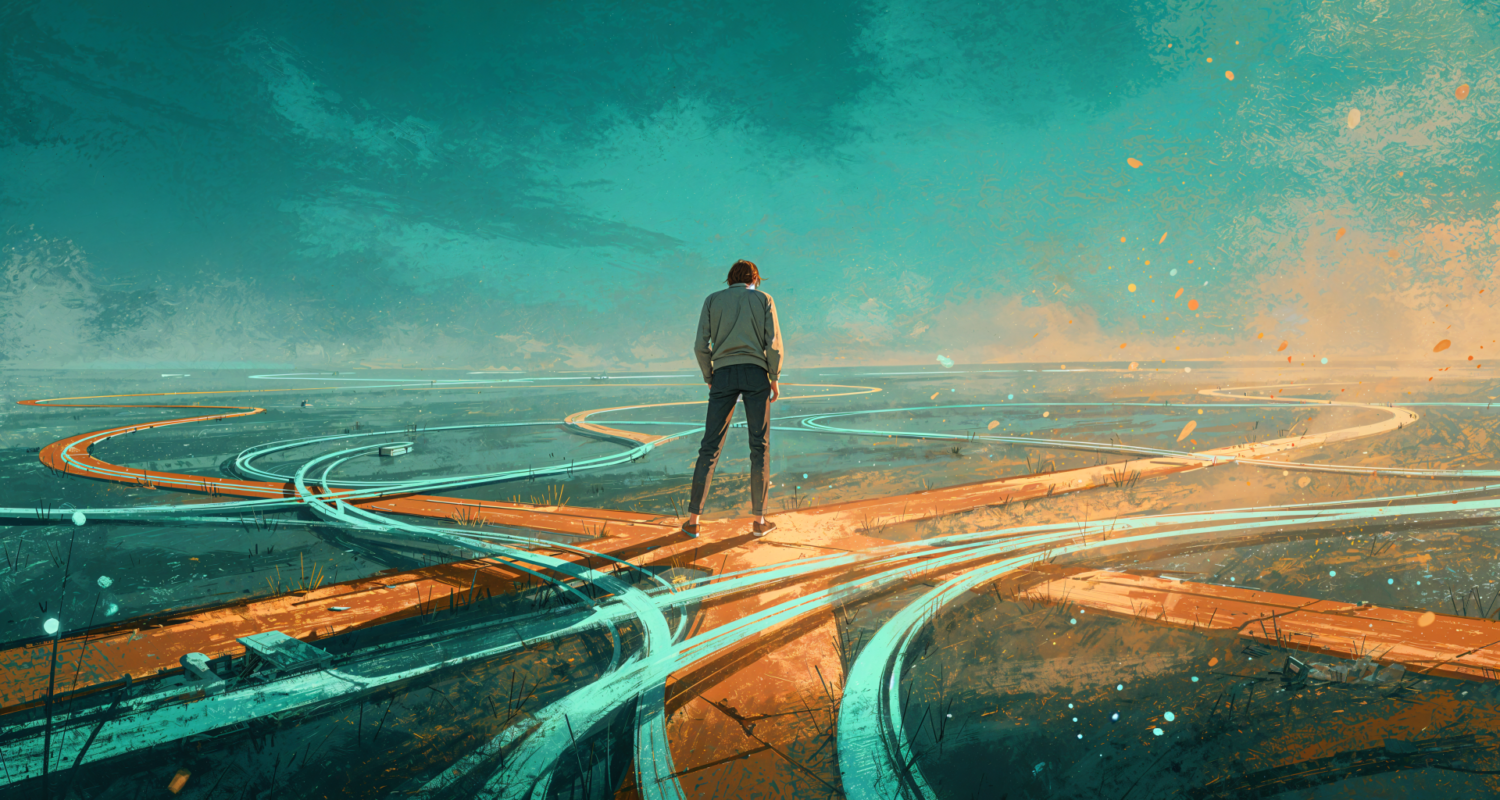
Žižka’s Crossroads is the more anxious of the two songs, its imagery deliberately paints an unstable yet quiet landscape – a hollow jar that cannot reach the “ocean floor”, “tangled strings” and a”vicious spider web”. These metaphors do not converge to a unified image and that is precisely the song’s literary contribution regrading the nature of choices in shaping our exercise of freedom in an otherwise absurd world. Jean-Paul Sartre, a renowned existential philosopher, famously coined the idea of Anguish – because objective moral rules are hard to define, every choice we make is a solitary act of creation that carries the weight of total responsibility. This idea is well-encapsulated within the lyrics of Crossroads, putting forward the proposition that choices do not simplify reality as we are made to believe – they fracture it. Every decision doesn’t close a door; it splinters the path further, revealing new strings, new spiderwebs and new crossroads.  Žižka’s lyrics also appear relevant in a day an age where the world appears more absurd than ever: His plea to his own mother or mother nature itself reflects this empathetically –  “Mother, I’ll get lost without a map”  is the emotional hinge of the song, a son reaching back toward certainty in a world that no longer offers any.

In contrast, Lion Ceccah begins from a place that might seem superficially simpler but proves on closer reading to be philosophically advanced. While Žižka stands paralysed at the crossroads, Ceccah seems to have already passed through it and emerged on the other side, not with answers but with a deeper, more troubling question that is likely to lead to another wave of fractured choices. The opening verse of Sólo quiero más (Based on an official translation from Lithuanian to English) is quietly devastating: “It frightens me, haunts me everywhere I am / Those who dare, ask: why do I live?”. The second verse compounds this: “I keep spinning again and again, the shores of truth are shrouded in fog”. Universally, across philosophical traditions, humans are urged to look inward to derive meaning. Yet time and again, the stories of great thinkers—from Socrates to the Buddha to the mystics of every era—suggest that introspection rarely delivers the neat clarity we expect. Instead, it often exposes deeper contradictions, more unsettling questions, and a sense that meaning is something we must continually reconstruct rather than discover. Ceccah’s lyrics sit squarely in this lineage: not the voice of someone beginning an existential journey, but of someone who has already walked through the fire of self‑interrogation and realised that the search itself may be the only constant. Through this lens, the song’s titular plea – “I want more” – is not an expression of greed but the cry of a humanity dissatisfied with the hollow answers its own choices have produced.

The Role of Authority: Mad World and Golden Cages

If the first theme questions the nature of choice, the second asks what we choose to submit to and both songs arrive at a partial verdict on the structures humans erect to escape the burden of the world. 

Žižka is startlingly direct. “We try our best to operate on pure love and rage / Ungrateful child in a golden cage”. This is one of the most arresting images in his lyrical story: love and rage reimagined as humanity’s most primal forces (energies we like to frame as liberating, yet which ultimately power the very machinery of human existence). The golden cage is an equally vivid symbol: it represents a life shaped by expectations, comforts and identities we never consciously chose and it these structures that glitter from the outside yet constrict us from within. Once again, Sartre’s ideas, especially his notion of bad faith, feel very relevant here. Bad faith is the act of convincing oneself that one’s situation is fixed and externally determined; it is often seen as the surrender of freedom disguised as necessity. Žižka’s “ungrateful child” inhabits precisely this condition, dimly aware of the bars yet unable, or perhaps unwilling, to name them. The most haunting lyric that closes the bridge of Crossroads before the high notes start to rise is the moment the song finally admits its most blunt truth – “Man cannot change”. In Žižka’s framing, this statement reflects that humanity keeps living in bad faith, avoiding the big questions and surrendering to the pull of authorities, systems, and inherited structures. We stay in the golden cage not because we must, but because we accept it—mistaking constraint for comfort and choosing the familiar over the terrifying work of change.

Sólo quiero más approaches the same trap but lists this traps and achieves a conclusion regarding their role in the creation of meaning. In the chorus, Lion Ceccah creates a powerful image and subsequently a thought experiment: “Even if there’re no more gods to pray for / Even if we’re standing as the sky falls” — in two lines he dismantles both religious and cosmic authority as possible sources of meaning. This is not nihilism but something closer to what Sartre meant by radical freedom: the moment one accepts that no higher order will hand down purpose, one is finally, terrifyingly, at liberty to create it. The absence of gods is not a catastrophe in Ceccah’s universe but a clearing — a space in which the bigger questions about human meaning can finally be asked. And crucially, he doesn’t replace God with ideology, institution, or romantic love, the usual substitutes humans reach for when one golden cage collapses. He replaces nothing. He simply continues wanting. In this sense, Sólo quiero más becomes the more philosophically consistent position: if the cage is a form of bad faith, the only honest alternative is to refuse all cages and remain in the uncertainty of open water. It is a posture that accepts meaning as something to be made, not inherited, and recognises that the search itself may be the only stable ground we ever stand on.r.

The Pursuit of Nothingness: Man Cannot Change

At the end of both journeys, the songs converge on the same uncomfortable truth – Humanity, in these two visions, is a condition that exists and at its universal core we are unlikely to change. 

Žižka delivers his verdict in the song’s final line: “Man cannot change”. It lands with almost flatness with no drama or consolation. Read within the framework of the song, the line carries a kind of Stoic weight. Marcus Aurelius returned again and again to the distinction between what lies within our control and what does not. The external world, other people, the direction of history — none of these can be mastered. What remains is the quality of our response. Žižka’s conclusion follows this logic. The human tendency to fracture reality through choice, to step into golden cages, to search for maps in a world that cannot be mapped — these are not errors to be fixed. They are part of what it means to be human. The final word of the song is not a solution but a position: Crossroads. It marks a loop rather than an ending.

Lion Ceccah arrives at the same destination, but by a longer and more troubled route. “Pain and joy, that is life / like an old film, pain creates music that connects without words” — here the song reaches its most reflective point, suggesting that suffering is not separate from meaning but one of its sources. This aligns closely with Nietzsche’s idea of amor fati: accepting the whole of existence, including its difficulty, as the ground on which a real life is built. Towards the end of the song, the title (originally in Latin) is repeated across seven different languages. Similar to Žižka’s universal declaration that “Man cannot change”, this is Ceccah’s way of expressing the universality of the human condition: we will never be fully satisfied with our answers to the big question, and we will keep building systems, structures, and cages that hold us in place. They offer only a brief sense of meaning, just enough to carry us forward, but never enough to resolve the deeper uncertainty that follows us through life.

We are caged and lost animals, and instead of resolving our deep‑seated need to draw meaning from life, we keep building new cages to create small, personalised versions of meaning. These structures only multiply the choices available to us, leaving us caught in fractured webs of paths that never lead to lasting satisfaction. We keep wanting, keep searching, and keep falling short of the “enough” we imagine exists somewhere ahead. In the Eurovision world of three‑minute pop songs, that is not a small claim — which makes Lithuania’s and Czechia’s entries unusually bold contributions to the contest’s artistry and certainly to existential philosophy.

Continue reading
Written by: Mineka
Critique Corner My Writing Corner

Sergio Leone’s Desert of Absurdity: Extracting the Existential Philosophy of “The Good, The Bad & The Ugly”

July 22, 2024 No Comments

Sergio Leone’s Desert of Absurdity: Extracting the Existential Philosophy of “The Good, The Bad & The Ugly”

Once upon a time in the old wild west, an artist would have painted the world he knew as an endless desert embellished with cutting cacti, rugged rocks and the sparse traces of a traumatised society in the form of scattered, ramshackled towns with bleak wells, empty churches and a running knot on a desolate tree. Riding on their resilient horses while chanting ballads, through this nihilistic desert of solitude would be the iconic gunslingers, cowboys and bounty hunters of the age who lay in an endless struggle to seek the key to their existential freedom in an undefined world of undefined rules. This is the landscape that effectively embodies the cinematography of the Great Western Films, such as those of Sergio Leone’s. Amidst the echoes of galloping horses, firring gun shots and civil war screams, these films encapsulate stories that defined this unsteady era and through a retrospective perspective, the story of America itself as it evolved from a primeval cowboy society to a dynamic superpower that we now call the United States.

Directed by Italian filmmaker Sergio Leone and released in 1966, “The Good, The Bad and The Ugly” stands as arguably the greatest Western ever made, owing to its deceptively simple narrative that seamlessly amalgamates the aesthetics, ideals, and spirit of the Old Wild West. With its immaculate score by Ennio Morricone, exquisite cinematography by Tonino Delli Colli, and stellar performances by Eastwood, Wallach, and Van Cleef, the film earns its place as a cinematic masterpiece-a poignant reminder of the harsh realities of the Old West. In essence, the film follows three gunslingers-Blondie (The Good), Tuco (The Ugly), and Angel Eyes (The Bad)—as they navigate the tumultuous backdrop of the American Civil War in an unrelenting quest for a hidden cache of gold. Each character embodies distinct moral shades, weaving a complex tapestry of alliances and betrayals that culminates in an iconic three-way stand-off at a remote cemetery where the gold lies beneath an unmarked grave. While Westerns primarily entertain, they also serve as fertile grounds for analysis, offering profound themes and motifs that resonate deeply. In this review, I endeavour to unravel the layers of meaning within the film through a philosophical lens, exploring its existential and nihilistic underpinnings, and discerning their broader significance in the grand scheme of cinematic tradition.

The Absurdity of The West: No Order, No Meaning and No Purpose

Jean-Paul Sartre, famed for pioneering most ideas in existentialism addresses the concept of an absurd world in several of his works, particularly in “Being and Nothingness” and “Existentialism is a Humanism”. These ideas are consistent with the depiction of the Old Wild West in cinema which primarily characterises it as world devoid of inherent meaning, order and purpose that is not reinforced through any system of governance, nor a system of theocracy. Through this perspective, Tuco, Angel Eyes and Blondie can be all empathised as victims to this meaningless world as the navigate the abyss of the American desert in search for truth while simultaneously realising that the world they live in is deprived of a preordained plan or divine blueprint that would otherwise guide their human existence to actualisation. The Absurdity of the West is primarily embodied by three features that characterise the essence of this era: the lack of order, the lack of religion and the lack of purpose.

The lack of order is one reinforced through many anecdotes including the disunity among public institutions between counties over the hanging of Tuco, the power of bandits over the unionists, and the hedonistic behaviour of union officials as they indulge in death and drinking. In this gritty landscape, lawlessness reigns supreme, with no centralised authority to enforce justice or maintain order than the characters themselves who all work according to their own self-engineered moral compasses. The conflicting jurisdictions and arbitrary decisions regarding Tuco’s fate illustrate a lack of cohesive governance, where individual interests and power dynamics dictate outcomes rather than principles of fairness or legality. Moreover, the dominance of bandits over defenceless communities underscores the absence of protective institutions and the vulnerability of ordinary citizens to exploitation and violence. The hedonistic behaviour of union officials further reflects a moral vacuum, where those in positions of authority prioritise personal gratification over the welfare of the people they ostensibly serve. These examples paint the film’s world as one whose rules are arbitrary, law is futile and justice is elusive, leaving individuals to fend for themselves thus deducing the Sartrean definition of an absurd world as being devoid of order.

In the absence of a structured secular governance, one might expect a theocratic rule akin to the Middle Ages to dictate human existence. However, in “The Good, The Bad and The Ugly”, even religious institutions appear abandoned, adding a poignant layer to the absurdity of the Old Wild West. The depiction of religion is starkly evident in the dilapidated church where Tuco and Blondie seek refuge. Its shattered windows, crumbling walls, and decapitated statues of Christ amidst rusty crosses evoke a sense of spiritual decay amidst the anarchy that defines this universe. Tuco’s frequent signage of the cross during morally ambiguous situations, which one would see as being hypocritic, actually serves as a cynical commentary on the inefficacy of religion in providing meaning and guidance during times ravaged by war and hardship. Furthermore, the poignant exchange between Tuco and his priest brother underscores the confrontation between the people of the West, represented by Tuco, and the waning authority of God and religion, embodied by his priest brother. The outcome of this confrontation-Tuco striking his brother in response to a slap-symbolises the diminished influence of religion and its precarious position in governing a lawless land dominated by figures like the film’s titular characters. Moreover, it is the graveyard at the film’s resolution that stands as the most prominent testament to religion’s lingering presence. With its countless crosses marking graves in eerie stillness, it effectively symbolises the death of God and the fading relevance of religious institutions in guiding the anarchic world of the old wild west which logically justifies the chaotically immoral behaviours of the film’s titular charters.

From the anarchic governance and the fading church emerges a profound existential void among the ordinary folk navigating secluded hamlets and the endless deserts in the film. Echoing Sartrean existentialism, which asserts existence precedes essence, the characters in this absurd landscape confront a world where choices and judgments fail to imbue life with a meaningful essence. Unlike Sartre’s theory that individuals define essence through choices, the film’s context undermines any innate drive toward self-actualisation or transcendence. Secondary characters like Bill Carson and Angel Eyes’ employer, Baker, epitomise lives mired in mere survival rather than the pursuit of essence. Their existence is shaped by the harshness of their environment-war, scarcity, and lawlessness-forcing them to prioritise material needs over emotional fulfillment. This philosophical exploration portrays individuals constrained by circumstances, navigating a world where existential meaning takes a backseat to the relentless struggle for survival and material gain. However, the three titular characters challenge the notion that essence is irrelevant in this world. Amidst the chaos of improper governance, faded religion, and societal decay, they embody a drive to attain the cache of gold-a symbol of material wealth beyond the reach of secondary characters. In this lawless frontier, they pursue self-actualisation through the acquisition of wealth, conflicting with conventional standards where such pursuits would be deemed noble. In this harsh and individualistic world, their quest for gold represents symbolises an existential search for freedom and transcendence, that the titular characters are willing to taken even at the cost of the lives of others.

In summary, through existential reasoning, as guided by Sartrean ideas, we have discovered how “The Good, The Bad and The Ugly” vividly illustrates an absurd world that is devoid of inherent meaning characterised by its lack of structured governance, healthy religious institutions and struggle for basis necessities among the commoners. Amidst lawlessness and the decay of religion, the titular characters embody a stark contrast by individualistically pursuing material wealth beyond necessity as means of existential fulfillment. Consequently this ‘search for gold’ becomes the film’s definition of ‘self-actualisation’ or ‘living a life of essence’ which evidently challenges the conventional notions of self-actualisation being a noble endeavour in the modern world. In fact this landscape sets the backdrop for not just this film but all Western’s and can lead to further arguments such as the significance of morality within absurdity and how it leads to nihilism.

Radical Freedom and the Birth of Moral Nihilism

Similar to Sartre, Nietzsche argues that the world inherently lacks purpose and meaning, compelling individuals to construct their own moral codes of conduct and value hierarchies in order to deliver depth to their existence. Nietzsche’s concept of the “Übermensch” embodies this idea, depicting an individual who transcends social norms and embraces personal strength to assert freedom and authenticity. In the peculiar world of the Old West, where man is at the centre of his existence, detached from the idiosyncrasies of systematic rules, morals, and a Good God, he epitomises the “Übermensch” in the pursuit of self-interest. Through a Sartrean lens, it is in fact the ultra-absurdity of the west that instils the film’s titular characters with a form of radical freedom, allowing them to construct their own moral ethos, which they embrace in their existential quest for the cache of gold.

Blondie, “The Good,” adheres to a personal code of honour and justice. Despite his actions resonating moral ambiguity as we see later on, he demonstrates a consistent, albeit self-defined, sense of fairness. For instance, his decision to free Tuco from his noose at the film’s resolutions demonstrates his adherence to a personalised moral compass that embodies altruistic values such as prioritising human life over mere profit.

Meanwhile Tuco, “The Ugly”, carries a more chaotic and opportunistic moral compass that is governed by survival and self-interest exemplifying moral nihilism through his unpredictable actions and lack of consistent principles. But despite the moral ambiguity of his compass, he still embodies some degree of empathy particularly when he adheres to his alliance with Blondie or sympathises the death of mother, revealing to us that his decision pursue a life of crime was driven by his predicament between poverty and survival.

Lastly, Angel Eyes, “The Bad”, epitomises the darker corners of existential freedom. He constructs a moral framework centred around ruthless efficiency and personal gain. His unwavering pursuit of the gold, regardless of the cost to others, highlights a nihilistic detachment from conventional morality. His actions, such as cold-bloodedly killing his employer and abandoning his equipe encapsulates a complete rejection of traditional ethical constraints in favour of an unrelenting pursuit of power. However, despite his labelling, he still kills to meet his ends meet and unlike Leone’s other characters in the Dollars Trilogy like El Indio and Rajmon, Angel Eyes illustrates no signs of sadistic behaviour in that he derives hedonistic pleasure from the act of killing.

In summary, within the expanse of the Old Wild West that is devoid of divinity and law, the titular characters of “The Good, The Bad and Th Ugly” navigate this absurd world by forging their own paths to existential freedom that are guided by their own moral compasses. As consistent with the existential ideas of Nietzsche and Sartre, the radical freedom these characters derive leads to a sense of moral nihilism with self-interest being far respected than human life signified by the normalisation of killing throughout the film. However, each character exhibits this at varying levels signifying the ambiguity and inner complexity of the moral compasses they carry through their journey to freedom.

The Ambiguity of Morality

Continuing our discussion regarding morality and its ambiguity when examining the ethos of each of the titular characters, we reach a stunning insight that validates the perplexing nature of morality. With ideas proposed as early as the classical age where Ancient Greek philosophers like Protagoras stated how “Man is the measure of all things”, truth and morality are seen as relative to each individual’s perception. Existentialist figures like Albert Camus who evidenced how morality loses its significance in an absurd world such as the old wild west, further confirm and lead to a single proposition on the black-and-white nature of morality. To logically understand the morality of the titular character’s actions and how well the characters fit into their titles, we can use their body-count (kill-count) as a proxy that effectively quantifies their moral compass. The bar chart below visualises the three character’s body counts which have been further split into categories denoting killing for self-defence as opposed to individual gain.

The chart instantly conflicts with the titles of the characters upon realising that Blondie (The Good) bears the highest number of killings followed by Tuco with Angel Eyes (The Bad) having the lowest number of kills. Through the utilitarian theory of morality, actions are defined as moral if they generate wide-spread wellbeing and immoral if they reduce wellbeing. In terms of the classic ethics problem, The Trolley*, Blondie has symbolically killed 5 people than 1 making him the immoral being and Angel Eyes the moral being.

Despite our confounding insights however, that misalign with the theories of utilitarianism, if we expand our understanding of morality, we would have to streamline the intentions of each kill and group them accordingly. For simplicity, we assume that each character can kill either for individual gain whereby secondary characters are eliminated who would otherwise interfere with their existential quest or for self-defence where the characters find themselves in an antagonising situation where killing is justified. Through this view, Angel Eyes killings are all for individual-gain which is significantly higher than the deaths caused by Tuco and Blondie who in certain situations kill for self-defence. Therefore, we can confirm the suitability of each character for their title and determine that their actions are morally justifiable by the ethos they’ve chosen to adopt.

Nevertheless, this quantitative analysis that leverages body count as a proxy for morality is still reductionist in execrating details regarding morality. The film still carries with it, its question regarding moral ambiguity and its conflicting metaphysics that are evinced by the perplexing behaviours of its characters. The Good is sometimes ugly, the ugly is sometimes good and the bad is sometimes good. This message of moral complexity is probably the most evident and applicative in the film which relates to the absurdity of the world and the struggle humans undergo in constructing their ethical ethos that guide their human existence. Nowhere is this more evident that in a world like 1860s America which lacked order, religion and purpose while being fragmented by bandits, ravaged by poverty and engulfed in civil war.

CONCLUSION

In the extensive portfolio of Western Cinema, “The Good, The Bad and The Ugly” stands out as one of the greatest westerns ever made due to it simple yet compelling narrative complemented by its immaculate score, breath-taking cinematography and fine casting. Beyond its cinematic quality however, the film offers us a window into the old wild west which through analysis and though reveals a profound exploration offering a profound exploration of existentialism and moral nihilism. By navigating an absurd world devoid of inherent meaning, order, and divine guidance, the film’s titular characters embody radical freedom, crafting their own moral codes amidst chaos. Blondie, Tuco, and Angel Eyes serve as vivid illustrations of Nietzschean and Sartrean philosophies, where self-constructed values and personal strength define their paths to existential fulfillment. This cinematic masterpiece, with its rich thematic layers and iconic storytelling, not only entertains but also invites viewers to reflect on the deeper philosophical questions about morality, freedom, and the human condition. The film’s portrayal of moral ambiguity, where traditional notions of good and evil are blurred, challenges us to reconsider our understanding of ethics in a world marked by absurdity and complexity.

Further Philosophical Examinations

Despite the end to our analysis, that mostly tackled themes of existentialism and morality, there are still several unharnessed philosophical intuitions rendered by the film that would be useful for future analysis and thought experiments. The following list condenses these ideas that are worthy of further questioning:

  • The Theological Case of A Good God: In an absurd world like the old west, who is in charge of morality and what does the crude brutality and harshness of this world tell us about the nature of a ‘good’ god. Could Blondie be the encapsulation of God itself for he sets the norms, constructs and morals of each situation and is effectively in control of the film’s plot as he in the final sequence unloads Tuco’s gun and shoots Angel Eyes. Does his anonymity hint his existence as God? Does his control yield him with God-Like Powers? If so, does his presence provide evidence for the theological case of a Good God?
  • The Paradox of Pleasure: Tuco ecstatically circles the graveyard for a fleeting minute of happiness which instantly extinguishes as he reached the wrong grave. Does this hint at the paradoxical nature of pleasures like sex and money, no matter how much we pursue pleasure we are forever limited by it short-term nature and eternal need despite the fact that we all one day end up in the grave where the cache of gold was hidden. Money certainly unities us humans as we pursue pleasure but are the titular character really desiring the money itself or simply the idea of money? Does money actually liberate us from suffering or is it a key to further existential anxiety?
  • Metaphysics of Justice: Is justice natural and who enforces it? By Angel Eyes being killed, justice is reinforced in the film where the Bad is punished. Similarly, by placing Tuco into a noose balancing on a cross, his actions are punished but only temporally before he claims his reward through great difficulty. What does the film hinder at the metaphysics of justice and is it part and parcel of nature meaning that it is naturally reinforced irrespective of the moral compasses we choose to follow?
  • The Trolley Problem – A thought experiment in moral philosophy where a runaway trolley is heading towards five people tied up on the tracks, and you can pull a lever to divert it onto another track, where it will kill one person instead of five. This dilemma explores the ethical implications of active intervention versus passive inaction and the moral calculus of sacrificing one life to save many (Foot, 1967).
Continue reading
Written by: Mineka

ABOUT ME

Welcome, curious wanderer! I'm Mineka, a student living in Melbourne, and this is your window to explore the depths of my intellectual journey. Delve into the realms of philosophy's timeless questions, immerse yourself in the rich tapestry of global literature, and uncover the strategies shaping modern business innovation. Join me on this intellectual odyssey as we navigate the pathways of knowledge that inspire my growth and passion. Welcome aboard!

Popular Posts

The Pretty Petty Ironies of Life!

The Pretty Petty Ironies of Life!

Meaning Under Pressure: The Existential Lyrics Driving ESC 2026’s Lithuania & Czechia

Meaning Under Pressure: The Existential Lyrics Driving ESC 2026’s Lithuania & Czechia

May 10, 2026

Mobiel spelen bij Baloo Casino: wat zijn de mogelijkheden?

March 13, 2026

Tortuga Casino est-il une plateforme transparente pour les joueurs ?

January 28, 2026

Betspino Casino: Een kijkje achter de schermen

February 8, 2026

MY WRITING CORNER – CATEGORIES

  • Pulse of the World
  • Critique Corner
  • Research Desk
  • Philosophy Symposium
  • Creative Chronicles

Open Mic – Categories

  • Current Affairs
  • History, Arts & Humanities
  • Science & Technology
  • Philosophy & Stoicism

Lifestyle Collective – Categories

  • IN-CAFÉ CINEMA
  • IN-CAFÉ JUKEBOX
  • IN-CAFÉ LIBRARY
  • IN-CAFÉ MAP

Recent Posts

Meaning Under Pressure: The Existential Lyrics Driving ESC 2026’s Lithuania & Czechia

Meaning Under Pressure: The Existential Lyrics Driving ESC 2026’s Lithuania & Czechia

May 10, 2026
Collapsed Regimes, Nuclear Disarmament and EU Solidarity: The Hidden Politics behind 5 Eurovision Classics

Collapsed Regimes, Nuclear Disarmament and EU Solidarity: The Hidden Politics behind 5 Eurovision Classics

Understanding Contemporary Digital Folklore: The Case of Backrooms, Cores and Liminal Spaces

Understanding Contemporary Digital Folklore: The Case of Backrooms, Cores and Liminal Spaces

April 26, 2026
The Mind Beyond the Brain: The Radical Science Behind Dan Brown’s Latest Thriller

The Mind Beyond the Brain: The Radical Science Behind Dan Brown’s Latest Thriller

Mobiel spelen bij Baloo Casino: wat zijn de mogelijkheden?

March 13, 2026

© 2025 copyright MINEKA'STHOUGHTTAPESTRY // All rights reserved
Designed by LI Studio