
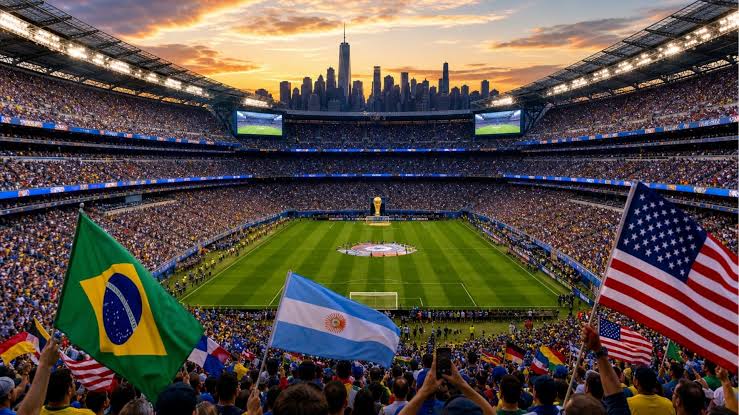
Dynamic Pricing, “Hydration” Breaks and Market Control: The Heavy Commercialisation of the 2026 FIFA World Cup
Dynamic Pricing, “Hydration” Breaks and Market Control: The Heavy Commercialisation of the 2026 FIFA World Cup
The 2026 FIFA World Cup arrives as the largest tournament in football history: 48 teams, 104 matches and a tri-nation stage set across Canada, USA and Mexico. It is being framed as a democratisation of the global game through a network‑effect logic in which more nations create more matches, more access, more fans and more money. Beneath this narrative of expansion sits a growing contradiction that has already been met with severe backlash from fans across the world. Rising ticket complaints, algorithmic pricing shocks and aggressive advertising campaigns suggest that access itself is being redefined as a premium product rather than a shared cultural right. This analytical piece argues that these shifts are not accidental missteps but planned strategies as a result of FIFA treating the 2026 World Cup as a laboratory for monetisation to pocket its anticipated $13 billion dollars in revenue in which global football meets the economics of US-Style commercialism.
What constitutes US-Style Commercialism?
- Extracting value though high pricing tolerance: US sports and entertainment markets normalise extreme price stratification, where elite attendance functions as a status good rather than simple access. This is reflective of the notion of cultural capital: attending becomes less about watching sport and more about signalling exclusivity. In such a system, paying high prices is internalised amongst consumers as a badge of honour and is eventually heavily tolerated and reflected in their willingness to pay for a single ticket.
- Navigating competition through threat elimination: US sports leagues and entertainment platforms systematically eliminate external competition through tight structural control, using closed franchise systems, exclusive broadcast rights and proprietary ticketing exchanges to extract value from the entire ecosystem rather than just the core event. Live Nation Entertainment shows this model in practice by promoting major stadium tours and funnelling all ticket purchases and resales through its Ticketmaster platform. Because it also stages many shows in venues it owns or operates, the company captures multiple layers of revenue from a single fan’s night out.
- Monetising on advertising normalisation and attention span: Unlike football’s traditional continuous narrative, US sport normalises interruption as a revenue mechanism. The game becomes a sequence of monetisable attention windows through curated and predictable ad breaks. In the Superbowl alone, US fans can spend up to an hour watching ads — a practice that is deeply rooted and normalised within consumer culture as a sort of compromise or economic trade-off to access content.
- Exploiting “car culture” as a revenue mechanism: US sport venues are usually built around car‑dependent infrastructure, enabling stadium economies to monetise not only tickets but access itself — parking, tolls, transport corridors, and surrounding commercial zones. These stadiums are often described in popular culture as ‘dystopian’ because, rather than functioning as integrated neighbourhood hubs, they operate like self‑contained entertainment fortresses. In practice, this allows these organisations to capture revenue at every stage of the fan journey, from the moment they enter the precinct to the moment they leave.
How has FIFA applied US-Style Commercialism?
Now faced with escalating revenue targets and a pressure to expand the tournament’s economic base, it appears evident that FIFA has effectively leveraged the core mechanisms of American sports capitalism including dynamic pricing and broadcast segmentation as tools to unlock new layers of value extraction in the 2026 World Cup. Compared to Qatar 2022’s subsidy-heavy access model and Brazil 2014’s relatively fixed pricing structure, the 2026 FIFA World Cup redefines commercialisation to a whole new level through numerous aspects of the tournament:
- Dynamic Pricing: One of the most evident and contested changes in this year’s World Cup was the adoption of dynamic pricing for ticket sales. Whereas Qatar 2022 relied on fixed tiers (including subsidised local categories) and Brazil 2014 maintained largely static price bands, the 2026 model introduces continuous, algorithm‑driven repricing that responds instantly to demand intensity and perceived scarcity. This approach mirrors US airline and ride‑share revenue logic, where volatility itself becomes the mechanism for value extraction. Combined with the relatively high willingness to pay in the North American market, dynamic pricing enables FIFA to stretch the price spectrum dramatically with some seats clearing above $30,000 while others fall below $100. In practice, this has produced a mixed outcome: price volatility has helped FIFA surge toward its $3 billion ticket‑revenue target, yet reports indicate that around 180,000 seats sat temporarily unsold because baseline prices had climbed far beyond what regular match‑goers could afford in a high‑inflation environment. Overall, the systematic US culture around pricing act as effective point of leverage for FIFA to justify their pricing strategy and it’s likely the strategy would pay off.
- Closed Resale Systems: In addition to the exorbitant prices created by dynamic pricing, FIFA has made a deliberate move to own and control the entire secondary market for ticket sales. The organisation built its own proprietary resale platform not simply to prevent unauthorised sales, but because the US sports market routinely tolerates platform‑controlled resale ecosystems with high fees and minimal regulatory scrutiny. As a result, FIFA can impose a combined 30% fee on every resale, allow prices to climb far beyond earlier public commitments, and release ticket batches in opaque patterns that many analysts interpret as engineered scarcity. These practices have already triggered investigations and legal complaints alleging monopolistic behaviour and misleading consumer conditions. Crucially, they mirror the commercial strategies widely accepted in US sport and entertainment, where eliminating external market threats enables a single operator to control pricing, distribution and value extraction across the entire ticketing ecosystem.
- Extended Hydration Breaks: While hydration breaks have long existed within FIFA’s framework in the name of player welfare, the 2026 tournament marks the first time they have been formalised into mandatory, scheduled stoppages with broadcasters encouraged to cut directly to commercial slots. If you were to watch a random match today, you would encounter eight 30‑second mid‑game ad slots created by the new hydration breaks — a sharp increase from the previous model, which offered zero commercial windows during active play. This shift directly mirrors US sporting events, where leagues like the NFL and NBA engineer artificial stoppages to create guaranteed, high‑value advertising pods throughout the game. This shift has drawn criticism from players and supporters including Netherlands captain Virgil van Dijk who argue that the interruptions disrupt competitive rhythm and edge football toward an American‑style, segmented match structure. The key change is not the presence of the breaks themselves, but their integration into a predictable broadcasting cadence that expands the volume of sellable advertising inventory. In effect, a welfare-based measure has been reframed as a commercial asset, aligning match flow more closely with US‑style media monetisation models.
- Half-Time Style Entertainment: In earlier World Cups, including 2014 and 2022, half-time functioned as a protected sporting interval—tactical adjustment, fan recovery, and uninterrupted broadcast analysis. In 2026, FIFA integrates large-scale entertainment productions into key matches, particularly opening fixtures and the final, echoing the Super Bowl model. On one hand, this could be read as FIFA’s attempt to expand football’s cultural relevance in the United States by adopting a broadcast format that American audiences already recognise and reward. However, in doing so, FIFA breaks from long‑standing football culture by effectively prioritising the expectations of a single host nation over the global norms of the sport. This shift has triggered significant backlash from fans and broadcasters alike, with the BBC making a notable announcement that it would cut the halftime performance entirely and move straight into match analysis.
- Driving culture and infrastructural extraction: Unlike Qatar 2022, where mobility functioned as a subsidised public utility through free metro access, and Brazil 2014, where transport systems were integrated into host‑city infrastructure, the 2026 model actively monetises mobility. Because most US host stadiums sit in car‑dependent metropolitan zones, simply reaching the venue becomes an additional revenue layer as fans face steep parking fees, toll‑based highway corridors and surge‑priced rideshare routes before they even enter the stadium. Nowhere is this clearer than MetLife Stadium, the site of the final, where the Meadowlands complex is almost entirely inaccessible by foot and deliberately engineered around private vehicle entry. International visitors report paying $98 or more for a peak‑day round‑trip train from Manhattan and over $300 for stadium parking, a pricing structure that effectively traps tourists into high‑margin transit options. These figures stand in stark contrast to the walkable, low‑cost or free mobility systems deployed at previous tournaments, revealing how FIFA’s 2026 design aligns with the broader American sports‑entertainment economy.
What emerges from this transformation is not simply a more expensive World Cup, but a shift from football as a shared cultural ritual to a massive revenue engine. While profit maximisation clearly underpins every decision FIFA has taken this cycle, deeper structural pressures help explain why this moment is so pivotal. One theory suggests that FIFA is responding to an existential threat from elite European club football, whose competitions now dominate global attention and sponsorship for most of the year. To prevent the international game from slipping into cultural irrelevance, FIFA must generate unprecedented revenue to fund rival properties like the expanded Club World Cup. A second theory centres on Gianni Infantino’s political survival: his power depends on the “one nation, one vote” system, which he sustains through generous development grants to smaller associations. To keep this patronage loop funded, he relies heavily on the vast commercial upside of the American sports economy. There might be deeper political reasons behind the rapid commercialisation of the 2026 World Cup, but what is certain—and has been proven countless times before—is that irrespective of FIFA’s practices, it is the fans and the spirit of football that ultimately energise the tournament. From the thunder of collective chants to the joy of micro‑nations announcing themselves on the world stage, and from rising stars to ageing legends making one last run, the emotional core of the World Cup remains stubbornly intact.








Leave a Comment